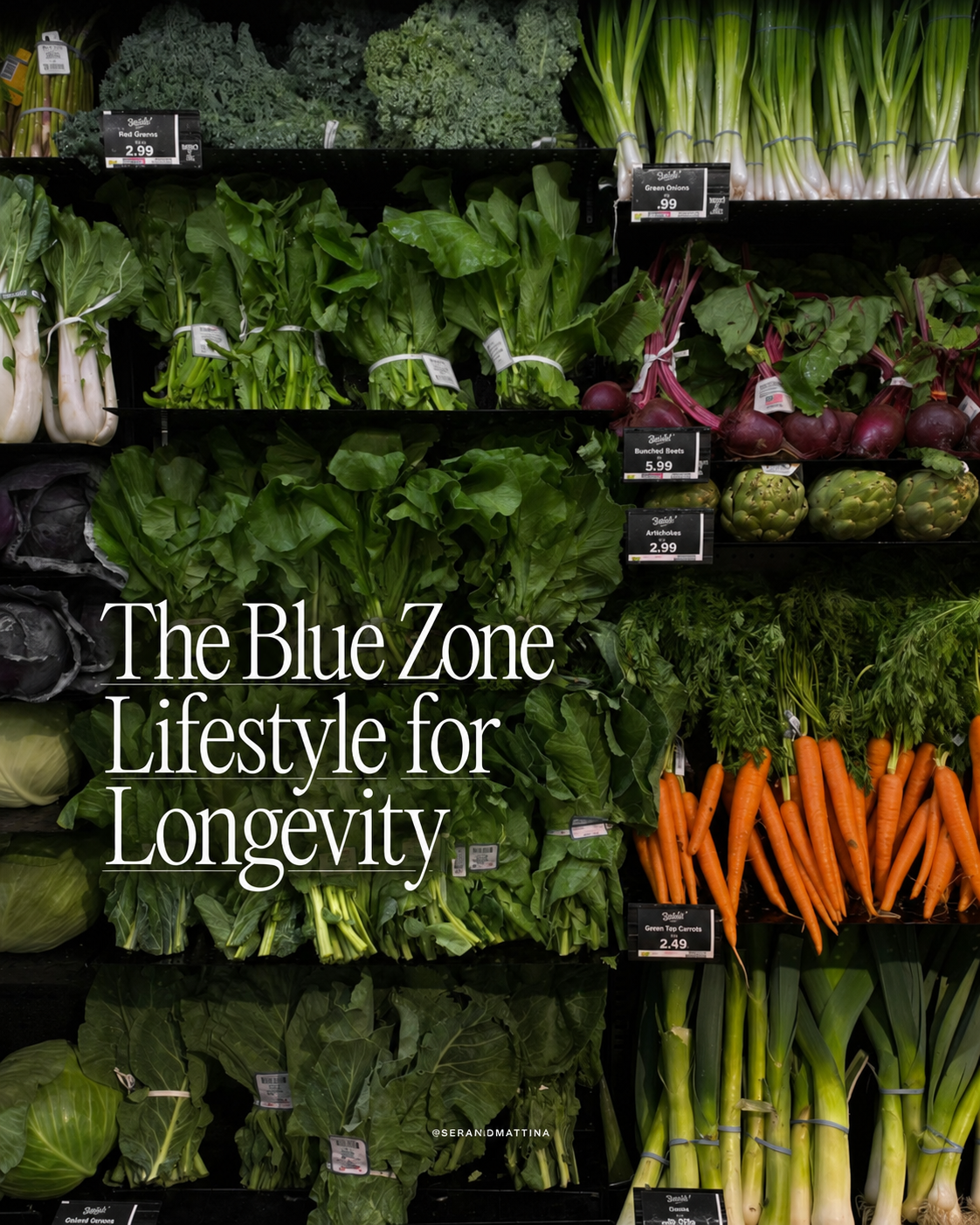
Credits: Pinterest
What the world's most famous longevity hotspots can (and can't) teach you, plus five habits that hold up even after the data debate.
It's 1 a.m. You just watched a 100-year-old Sardinian shepherd stroll up a hill you'd need a recovery day for.
The Blue Zone lifestyle promises something irresistible: live like the world's longest-lived people, and you might live longer too. But here's a thought: what if the Blue Zone lifestyle isn't a place you move to, but a version of yourself you build, one day at a time until you make it a habit?
Think about it. The women who seem to age with energy aren't living on a Greek island. They're the friend who walks to every coffee date. The one who always has a pot of lentils on the stove. The coworker with a standing Sunday call with her lola that she never cancels.
You don't need to herd goats, quit your job, or start a 5 p.m. wine ritual.
This guide covers what Blue Zones actually are, what the newest research (including the skeptics) says, and five longevity habits worth borrowing this week.
First, Can the Blue Zone Lifestyle Really Help You Live Longer?
Before we book the flight, let's talk science.
The story starts in Sardinia, where demographers Gianni Pes and Michel Poulain circled villages with unusually high numbers of centenarians in blue ink. Explorer Dan Buettner later expanded the idea into five regions: Okinawa (Japan), Sardinia (Italy), Nicoya (Costa Rica), Ikaria (Greece), and Loma Linda (California). He summarized their shared habits as the "Power 9": move naturally, have a purpose, downshift, the 80% rule, a plant slant, wine at 5, belong, loved ones first, and the right tribe.
Here's the plot twist. Demographic researcher Saul Justin Newman argues that extreme-age records in places like these are often unreliable, thanks to missing birth certificates, clerical errors, and even pension fraud. The work earned him a 2024 Ig Nobel Prize, a tongue-in-cheek science award. Blue Zone researchers pushed back that same year, saying they had verified ages against registries going back to the 1800s.
Even supporters see change. A 2023 study of Costa Rican records found that Nicoyan men born in 1905 had 33% lower adult mortality than other Costa Ricans, while those born in 1945 had 10% higher. The author concluded that longevity hotspots are probably temporary.
Translation? Whether these places are as extraordinary as the books suggest is genuinely up for debate.
But here's where things get interesting. Several Power 9 habits have their own evidence from large studies that have nothing to do with centenarian birth certificates. That's the part worth borrowing.
So instead of asking "how do I live to 100?", try this: what does the 80-year-old version of me need from me today?
1. Want More Energy Without Another Gym Membership? Try Moving Naturally.
For the girl who pays for three fitness apps and still logs 2,000 steps on deadline days.
People in Blue Zones don't famously "work out." They garden, walk to the neighbor's, climb stairs, and knead dough. Movement is built into the day instead of scheduled around it.
That idea holds up. A 2022 meta-analysis in The Lancet Public Health pooled 15 studies of nearly 50,000 adults and found that more daily steps were linked to a lower risk of dying early. The benefit leveled off around 8,000 to 10,000 steps for adults under 60, and 6,000 to 8,000 for those 60 and older. Walking faster didn't add much once total steps were counted.
These are observational findings, so healthier people may simply walk more. Still, it's an encouraging sign that you don't need a perfect routine to benefit.
The real-life takeaway: Pick one daily thing you'll do on foot this week: a call, an errand, or a lap around the block after lunch.
Movement doesn't have to be a session. It can be your lifestyle.
2. Want Food That Takes Care of Future You? Try a Plant Slant, Starting With Beans.
For the girl whose fridge currently holds four condiments and a lonely lemon.
Every Blue Zone eats legumes: fava beans in Sardinia, black beans in Nicoya, soy in Okinawa, lentils and chickpeas in Ikaria.
In a study of 785 adults over 70 across Japan, Sweden, Greece, and Australia, each extra 20 grams of legumes per day (roughly two tablespoons) was linked to about a 7 to 8% lower risk of death. It's a small, older study, so treat it as a strong hint rather than a rule.
Among 73,308 Seventh-day Adventists, the community behind the Loma Linda Blue Zone, vegetarians had 12% lower all-cause mortality than non-vegetarians. Worth knowing: the vegetarians also tended to smoke less and exercise more, so diet isn't the whole story.
This isn't a case for going vegan overnight. It's a case for plant-forward plates.
The real-life takeaway: Add one serving of legumes to three meals this week: chickpeas in your salad, a lentil soup, edamame as an afternoon snack.
Small swap. Long game.
3. Want to Feel Less Alone in Your Ambition? Try Building Your Moai.
For the girl whose closest friendships now live in a group chat she muted in March.
In Okinawa, a moai is a small circle of friends who commit to supporting each other for life. Many Blue Zone habits share this thread: family close by, faith communities, neighbors who notice when you don't show up.
The research on connection is some of the strongest in the longevity space. A 2010 meta-analysis of 148 studies covering more than 300,000 people found that stronger social relationships were linked to a 50% higher likelihood of survival, an effect the authors compared to well-known risk factors like smoking. It's observational, and the studies measured connection differently, but the pattern is hard to ignore.
The real-life takeaway: Name three to five people you want in your moai, then schedule one recurring thing: a monthly dinner, a Sunday walk, a shared class. If you need a starting point, a group hobby can double as your new tribe.
Your people are a health habit too.
4. Want a Reason to Wake Up That Isn't Your Inbox? Try Naming Your Ikigai.
For the girl who knows her quarterly goals by heart but can't remember the last time she asked "why?"
Okinawans call it ikigai. In Nicoya, it's plan de vida. Both roughly mean "the reason I get up in the morning."
In a 2019 study in JAMA Network Open of 6,985 US adults over 50, those with a stronger sense of life purpose were less likely to die during follow-up, even after accounting for many health and lifestyle factors. It shows an association, not proof, and it studied older adults. But purpose seems to be more than a feel-good extra.
Purpose doesn't have to be your job title. It can be your craft, your family, your community, or the thing you'd keep doing if nobody noticed.
The real-life takeaway: Spend 10 minutes with this prompt: "What would I keep doing even if no one paid me or praised me for it?" Our journaling guide to self-awareness has more prompts if you want to go deeper.
Your purpose doesn't have to be grand. It just has to be yours.
5. Want to Slow Down Without Falling Behind? Try a Daily Downshift.
For the girl who schedules her rest and then works straight through it.
Every Blue Zone has a daily pause. Ikarians nap. Adventists observe a weekly Sabbath. Okinawans take a moment to remember their ancestors. What stands out is that these pauses are rituals, not rewards for finishing your to-do list.
Modern research backs the idea of a regular reset. A 2021 meta-analysis of 31 randomized trials found that meditation lowered blood cortisol, a key stress hormone, in people facing illness or stressful life situations. Results from saliva tests were smaller and less consistent, so think of it as one helpful tool, not a magic switch.
The real-life takeaway: Choose a 10-minute downshift (a walk without your phone, slow breathing, a short prayer, or a real tea break) and anchor it to the same time every day.
The pause is part of the plan.
Make It Stick: Build Your Own Blue Zone Lifestyle
Start with the easiest habit, not the most impressive one.
Steps, beans, your people, your purpose, or your pause. Pick one.
Change your environment, not your willpower.
Blue Zone habits are built into daily life, not powered by motivation. Keep walking shoes by the door. Stock canned chickpeas. Put the monthly dinner on the calendar.
Track it for four weeks.
Not to grade yourself, just to see the pattern. If you love a little structure, our Printable Habit Tracker gives you one page to watch a new habit take root.
Bring someone with you.
A walking buddy or a lentil-soup co-chef turns a habit into a moai.
A Few Things You Might Be Wondering
What is the Blue Zone lifestyle?
The Blue Zone lifestyle is a set of habits observed in five regions linked to unusual longevity: Okinawa, Sardinia, Nicoya, Ikaria, and Loma Linda. Dan Buettner summarized them as the Power 9, including natural movement, a plant-forward diet, strong social ties, a sense of purpose, and daily stress relief.
Are Blue Zones real?
It's debated. Researcher Saul Justin Newman argues that extreme-age records in these regions are often unreliable, while Blue Zone demographers say they carefully verified ages. A 2023 study also found Nicoya's longevity advantage fading in younger generations. Even so, habits like walking, eating legumes, and staying connected are supported by separate large studies.
What do people in Blue Zones eat?
Mostly plants. Diets across the regions center on beans, whole grains, vegetables, greens, and tubers, with meat eaten occasionally rather than daily. Legumes are the common thread: fava beans in Sardinia, black beans in Nicoya, soy in Okinawa, and lentils and chickpeas in Ikaria.
Do I need to drink wine to follow the Blue Zone lifestyle?
No. "Wine at 5" is one of the Power 9 habits, but current health guidance doesn't support drinking for longevity. The World Health Organization states that no level of alcohol is safe for health. If you don't drink, there's no reason to start. The social ritual around it is the part worth keeping.
How do I start living a Blue Zone lifestyle?
Start with one habit for four weeks. Walk more throughout your day, add legumes to a few meals, schedule regular time with people you love, reflect on your purpose, or build in a short daily pause. Small, repeatable changes matter more than a dramatic overhaul.
